Detecting Emerging Drugs in LA County Overdose Deaths
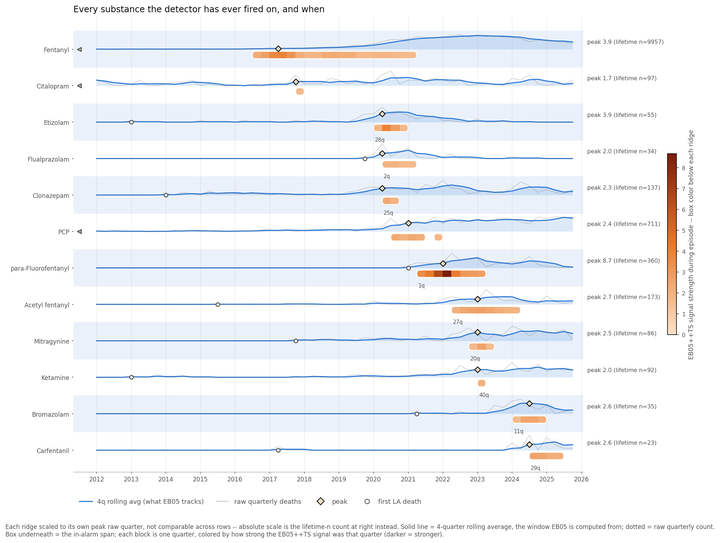 Every substance the detector has fired on since 2012. Boxes under each ridge mark the quarters in alarm; darker means a stronger signal.
The drug supply behind overdose deaths keeps changing: para-fluorofentanyl, bromazolam, carfentanil, xylazine. Death records usually can’t keep up. In Los Angeles County, the modeling panel carries just 8 coded substance flags and lumps everything else into “Others.” The medical examiner’s free-text cause-of-death narratives are far richer, and this project uses them to answer a simple question: which substances are emerging, and where?
- Extraction. A lexicon of 4,089 aliases mapped to 3,127 canonical substances, built from the DEA NFLIS catalog plus curated misspellings and metabolite rollups, turns 8 coded columns into 219 distinct substances at 99.8% decedent coverage.
- Detection. An empirical-Bayes (gamma-Poisson) shrinkage ranking flags substances whose share of deaths is rising. It combines case-weighting, dual-gate normalization, and a closed-form spatial-clustering term, alongside a tree-temporal scan over the pharmacological hierarchy. After prototyping more than 20 detector variants, the final design reaches 0.85 precision.
- Validation. Every variant is back-tested quarter by quarter using only the data available at the time, and scored against hand-curated emergence timelines and synthetic Monte Carlo profiles with known ground truth.
- Characterization. Spatial and space-time scans show whether a flagged substance is concentrated geographically, and polysubstance analysis separates substances that cause deaths from ones that are merely present.
